

PortaBilling serves as a Business Support System (BSS) and Online Charging System (OCS) for mobile operators across all network generations – 5G, 4G/LTE, and 2.5/3G. Three operator types are supported:
- Mobile Network Operator (MNO) – owns the radio spectrum and network infrastructure.
- Mobile Virtual Network Operator (MVNO) – uses an MNO's network under a commercial agreement and sells mobile services under its own brand. All deployment modes are supported: thin (reseller), service provider, and full MVNO.
- Mobile Virtual Network Enabler (MVNE) – provides shared BSS/OCS infrastructure to multiple MVNOs, while each MVNO manages its own product catalog, customer base, and, if required, its own mobile core elements.
PortaBilling supports two charging models:
- Real-time charging – PortaBilling communicates with the mobile network, authorizes, and charges each service usage in real time. See Real-time charging for details.
- Offline charging – CDR files with service usage are periodically delivered to PortaBilling and processed in batches. See Offline charging via xDR import for details.
Regardless of the operator type, PortaBilling can provision subscribers on the relevant network component (Home Subscriber Server (HSS) or Policy and Charging Rules Function (PCRF)) via External System Provisioning Framework (ESPF). See Subscriber provisioning for details.
Offline charging via xDR import
When real-time charging is not available, PortaBilling can process service usage records imported from files.
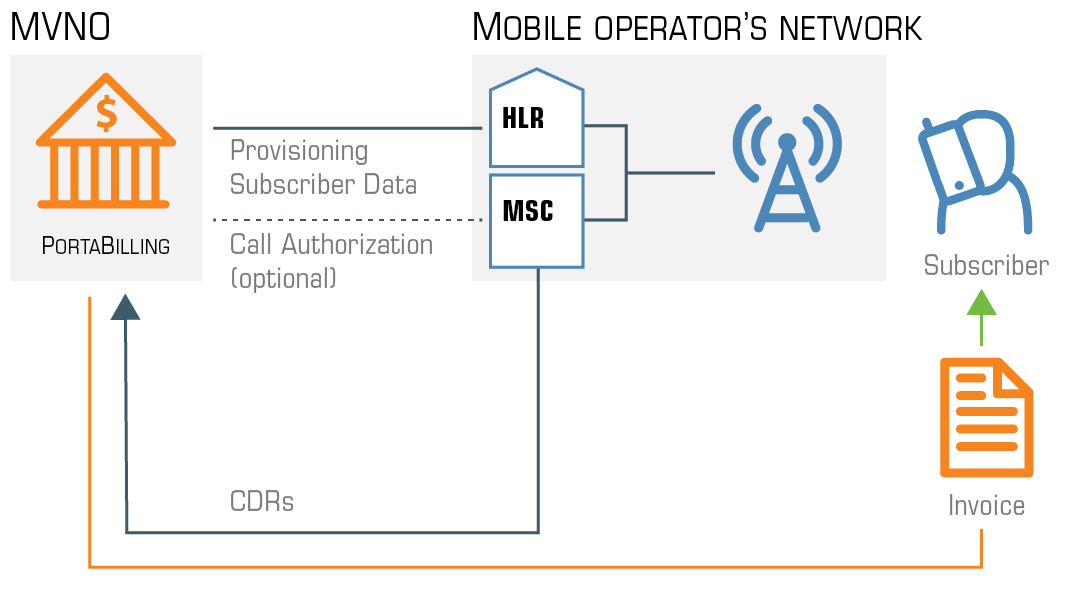
xDR import is used to process roaming charges delivered by roaming partners in TAP3 files. See Roaming for more details.
For deployments where the operator does not perform real-time charging, xDR import is also the primary billing mechanism. The network element periodically delivers CDR files for all sessions, which PortaBilling processes and charges subscribers accordingly.
See the xDR import chapter for more details.


