



A distributor is a point-of-sale agent who sells products and collects payments on behalf of the service provider. End users pay the distributor to purchase new products, settle invoices, or top up their prepaid balance. The distributor then transfers the collected amount to the service provider, minus their commission.
Distributors are not required to have technical knowledge. They receive physical products, such as SIM cards, in bulk in advance and distribute them to end users. Account management is handled through the web interface.
Accounts are supplied to distributors in an inactive state. An inactive account cannot be used to access services, which limits the impact of loss or theft. If a batch of cards goes missing, they cannot be used until activated. The distributor is charged only when an account is activated.
PortaBilling tracks each distributor's balance and credit limit. If a distributor's balance reaches the credit limit, they cannot activate additional accounts until they settle what they owe. This reduces the service provider's risk if a distributor fails to pay.
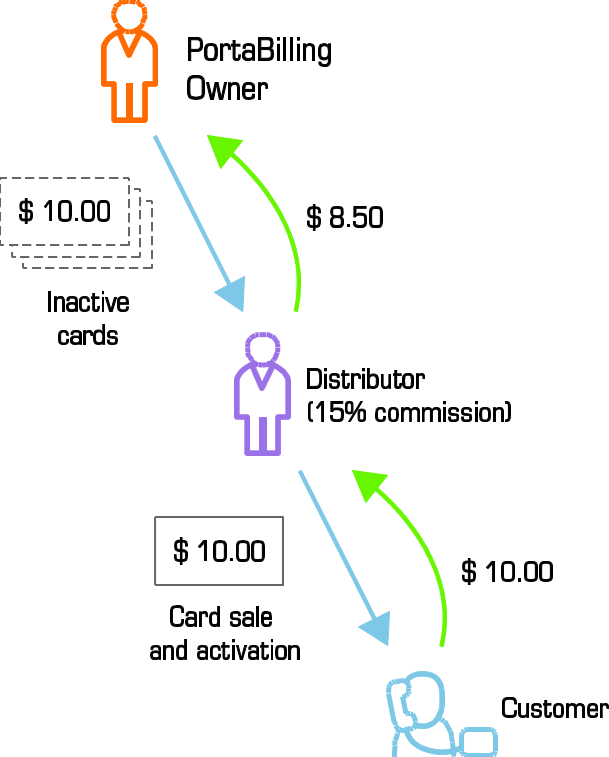
Two commission types apply to a distributor:
- Default sales commission – applied when an account is activated, or when a distributor is assigned to an already active account.
- Default payment commission – applied when a payment is recorded by a distributor.
PortaBilling updates the distributor's balance by the amount they owe the service provider – the transaction amount minus their commission.
Multi-level distributors
In the multi-level model, distributors can create their own subdistributors and share part of their commission with the latter. A subdistributor's commission cannot exceed the distributor commission defined by the service provider.
While distributors interact with both end users and subdistributors, subdistributors interact with end users only.
Before the SIM card is activated, PortaBilling checks whether the distributor's and subdistributor's balances are sufficient to cover it.
Owl Telecom administrator sets up John Doe as a distributor with a 20% payment commission. John Doe runs a network of small retailers and signs up Mary Smith – a local grocery shop owner – as his subdistributor with a 10% payment commission.
A customer visits Mary's shop and asks to top up their mobile balance with $10. Mary records the payment in the distributor portal. PortaBilling updates the balances as follows:
- The end user's account is topped up by $10.
- Mary Smith owes John Doe $9 ($10 − 10%).
- John Doe owes Owl Telecom $8 ($10 − 20%).
Distributor payment collection
Distributors record payments made by end users who cannot pay online. Distributors can record payments for any SIM card they sold, as well as for any other mobile subscriber of the service provider – even if the SIM card was purchased elsewhere.
When recording a payment, distributors can search for accounts only by entering a full account ID or a full phone number. This prevents distributors from accessing account information beyond what is necessary.
Distributors can only top up debit accounts and credit accounts with an individual credit limit.


Distributor xDR history
Distributors can view only their own xDR history, which consists of SIM card activations and payments.
Distributors can reverse payment transactions only if, for example, they recorded the wrong amount for a payment. xDRs produced for account activation are not reversible.

Distributor commission report
The commission report shows the distributor's profit from sales and payment collections: the commission percentage and commission amount for each transaction. To enable commission reports, set the Distributor_Commission_Report value in the CustomXDRReport.EnabledPlugins option on the Configuration server web interface.
Owl Telecom administrator creates John Doe distributor with a 20% payment commission. John Doe then creates Mary Smith as a subdistributor with a 10% payment commission. Mary Smith records a $10 manual payment for ABC company.
Mary Smith's commission report shows: commission percentage of 10%, original amount of $10, payout amount of $9, commission amount of $1.
John Doe's commission is the difference between his total commission (20%) and Mary Smith's commission (10%), which is 10%. John Doe's commission report shows: commission percentage of 10%, original amount of $10, payout amount of $8 ($10 − 10% − 10%), commission amount of $1.


