



A customer is a company or a person that uses services through one or more accounts and pays for those services. For example, in a mobile setup, each SIM card, whether in a phone or IoT device, corresponds to a separate account under the customer.
Depending on how an account is configured, charges for service usage either contribute to the customer's overall balance and are included in an invoice, or are applied to a separate balance maintained for that account.
Customers are divided into prepaid and postpaid, depending on how their balance is controlled.
Prepaid customers
With the prepaid balance control, customers pay first and then use the services. For example, they cannot make outgoing calls or access the internet until they top up their balance.
A prepaid balance shows the funds currently available for spending on services.
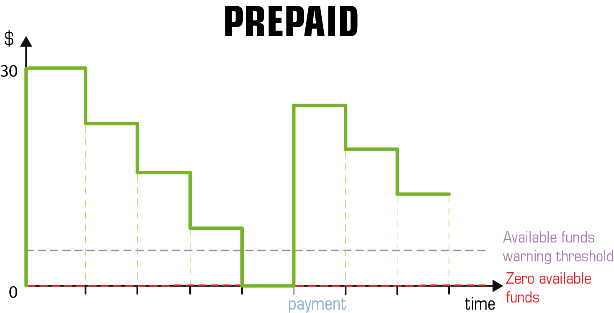
As the customer uses services, the available funds decrease. When the balance reaches zero, the customer cannot use the services until they top up the balance. After a payment, the available funds increase, and the customer can continue using services.
Typically used for: mobile subscribers.
Postpaid customers
With the postpaid balance control, customers use services within the defined credit limit and pay for them later, based on invoices generated at the end of each billing period.
A postpaid balance shows how much the customer currently owes the service provider. Once the invoice is paid, the balance decreases.
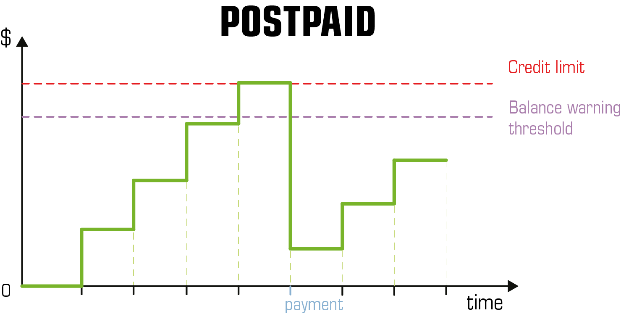
To reduce the risk of fraud and unexpected charges (for example, if an account’s credentials are compromised and used to generate a high amount of traffic), set a credit limit for postpaid customers. When the customer’s balance reaches the credit limit, the customer’s accounts cannot use services until the customer makes a payment and the balance drops below the credit limit.
Typically used for: businesses (e.g., companies using Cloud PBX or SIP trunking).
Balance models for common business scenarios
The table below shows how customer balance models are used in different business scenarios.
|
Business scenario |
Description |
Customer balance control |
Account balance control |
|---|---|---|---|
|
Cloud PBX, messaging, IoT/M2M fleets, or internet access for businesses |
The customer receives consolidated invoices for all services used by the customer’s accounts. The customer balance and credit limit are shared across all accounts under the customer. |
Postpaid |
Credit subordinate * |
|
Mobile services with a shared balance, IPTV, or internet access for consumers |
All accounts under the customer share the customer's balance. One person tops up the balance, and charges for all accounts are reflected on that balance. |
Prepaid/Postpaid |
Credit subordinate * |
|
Prepaid mobile services with individual balances per SIM card, Wi-Fi vouchers |
Each account prepays for its service usage. No invoices or statements are issued. Each account has its own balance and is charged independently. |
Irrelevant ** |
Debit |
* You can set individual credit limits for credit accounts, in which case, each account will have its own balance. Service usage on such an account affects both the account balance and the customer’s balance (or available funds). The account owner has to top up the account balance separately (manually or automatically).
** Each debit account has its own balance and is charged independently. The customer balance is not used.


