

Geo-redundant PortaSwitch provides a high-availability system that ensures services are uninterrupted even if the main site experiences an outage. In this configuration, every secondary site is fully redundant, i.e., hosts PortaSIP, billing instances, and database servers can operate in stand-alone mode. In the normal mode of operation, the secondary site communicates with the main site’s billing server and writes changes to the main database. The secondary site also communicates with its local database and API server (located at the secondary site itself).
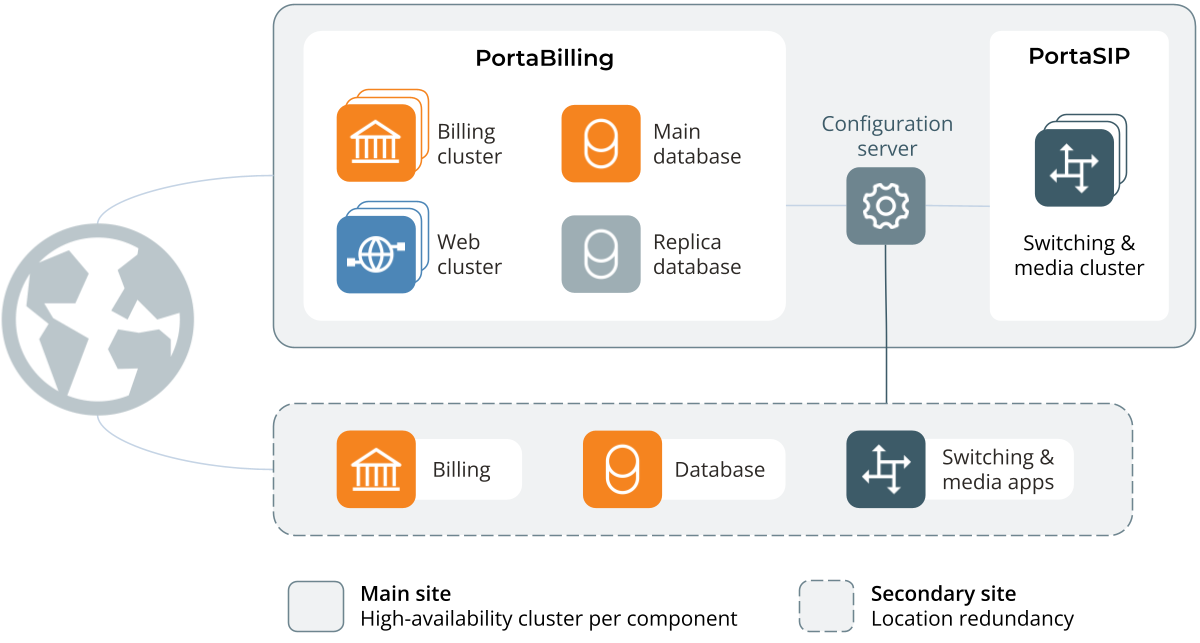
To optimize the network topology in your system, you can add softswitch-only secondary sites in different geographical locations and enable service failover for them. In the normal mode of operation softswitch-only secondary sites interact with PortaBilling and the database of the main site. At the same time, the switching and media applications on the secondary site communicate with their local database and API server. In stand-alone mode, softswitch-only secondary sites initiate service failover to the fully redundant site.
To begin providing services, the administrator defines the IP address of the site that is geographically closest to the user as the main registration point (e.g., for an installation where the main site is located in the US and the secondary site is deployed in Singapore, users from the US register with the US site IP address as their primary one while users from Singapore use the Singapore IP address as their primary one).
This way, users within a certain network connect to the closest available PortaSIP and enjoy uninterrupted services, even if the main site experiences an outage.
You want to start your business in Europe. You deploy the main site that hosts a standard PortaSwitch Clustered in Frankfurt. For high-availability, you deploy a secondary site which hosts a stand-by database server, PortaBilling server and PortaSIP in New York.
You also start a partnership with a reseller from Bulgaria who aims to serve thousands of customers there. Although the internal network links in Bulgaria are reliable and data transmission is cheap, outer connections are quite expensive. Therefore, to effectively handle Bulgarian traffic by using the network topology, you deploy a PortaSIP cluster within another softswitch-only secondary site in Sofia. In normal mode, this site, including their local database and API server, communicates with the main site in Frankfurt. In stand-alone mode, the softswitch-only secondary site initiates a failover to the secondary site in New York. Thus, your site configurations look like this:
- Frankfurt – the main site;
- New York – the secondary site with redundancy mode enabled;
- Sofia – the secondary site with the New York site defined as the failover one.
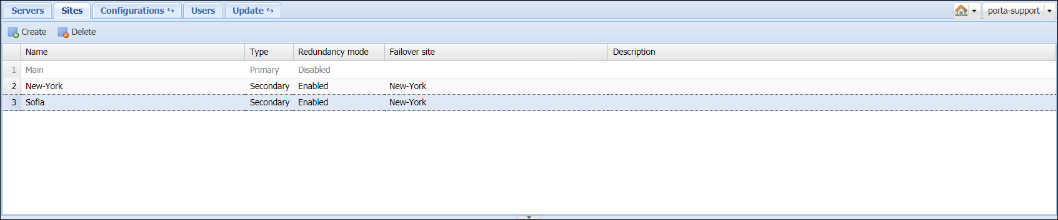
This allows for VoIP services to be efficiently provided in a situation which is highly typical for many countries or regions: good, fast Internet connectivity inside the country/region and mediocre connectivity with the rest of the world. For all users inside that region, VoIP traffic (signaling and RTP) will travel on the local backbone, while only small RADIUS packets travel to the central PortaSwitch location.
For the proper functioning of geo-redundant PortaSwitch, the sites must be interconnected and organized into a single virtual (or physical) private network.
Depending on whether you have your own network infrastructure or utilize the services of your network service provider, the following options are available:
- build/utilize an existing physical channel (wired/wireless) among remote locations on your own;
- rent/buy a virtual channel from your network service provider (L2VPN, L3VPN, VPLS);
- rent/buy a physical channel from your network service provider (L2 Data-Link);
- set up a virtual channel/tunnel over a public network on your own.
We recommend that you treat the last approach as a last resort measure since such tunnels could suffer issues due to poor connections.
In either of the approaches used, all the servers of the geo-redundant PortaSwitch must be connected via virtual (or physical) Layer 2 connection(s) and be configured as hosts in a single virtual (or physical) private network.
Thus, the geo-redundant solution enables service providers to:
- Provide services without disruption, despite whatever disaster might occur at any of the sites within the PortaSwitch network (fire, flood, power outage, etc.).
- Increase the number of processed call requests and balance loads among nodes within PortaSIP at every site.
- Optimize network topology and improve the quality of the services provided by defining the IP address of the site that is geographically closest to the user as the primary one to register on.
- Perform software upgrades to newer releases with zero downtime.
Voicemail processing in geo-redundant
Users of geo-redundant PortaSwitch can receive their voicemails virtually instantly even if the sites are located at a large distance that can cause considerable latency between sites.
When a voicemail is recorded by the IVR on a secondary site it is sent to the main site. After that, the voicemail is completely processed in one place – on the main site. There is only one transmission of the actual voice recording file across the network. This minimizes the time for voicemails to be processed and become available to users.
For example, you have a geographically dispersed installation where sites are halfway across the globe from each other – the main site in the UK and a secondary site in Singapore. For such an installation, the average time for voicemail processing may take up to 20 seconds. The actual voicemail processing time depends on the latency between the sites.


