



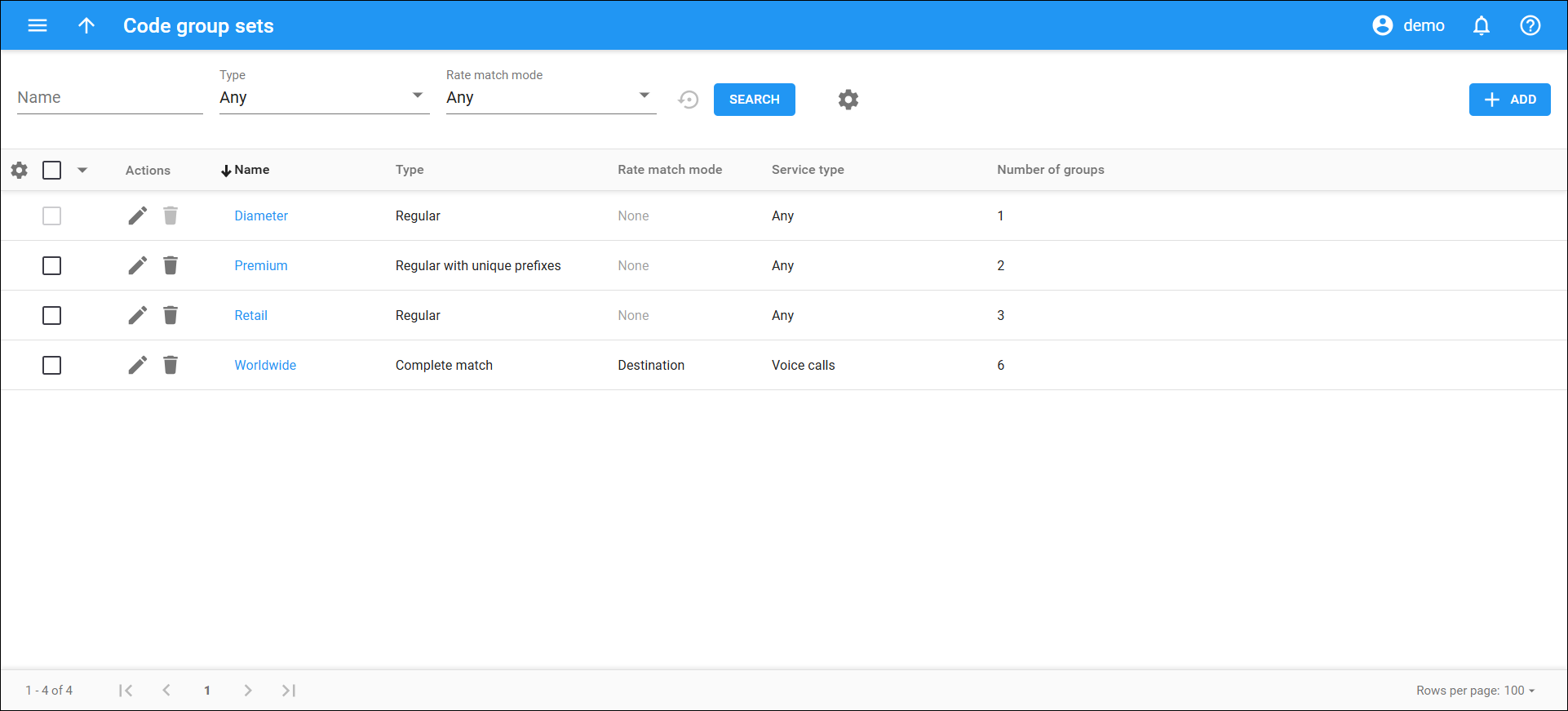
This panel displays the list of code group sets that match your search query.
To add a code group set, click + Add and fill in the details.
To edit a code group set, click its name or click Edit  .
.
To delete a code group set, click Delete  for that code group set.
To delete several code group sets at once, click the checkbox for each code group set you want to delete, then click Delete in the lower right corner.
Code group set search
Specify one or more of the search criteria listed below and click Search. If you want to stop the search, press “Esc” on the keyboard or click Stop  .
.
Click Default filters  to reset the search criteria to their initial values. To refresh the search results, click Search.
PortaBilling automatically loads the list of records once you open the page. You can turn off data autoload if you don’t want all the records to load each time you open the page. To disable data autoload, click Settings  and clear the check mark for the Automatically start searching upon opening the page option. When the check mark is absent, the records won’t load until you click Search.
If the search result contains a single record, you can open it automatically by choosing the If the search produces a single result, automatically open it option.
Name
Filter code group sets by their name. Type the code group set name fully or partially.
Type
Filter code group sets by their type:
- Select Any to search for all available code group sets.
- Select Regular to search for code group sets whose code groups contain only the rate codes explicitly assigned to them, with the same rate code allowed in more than one group.
- Select Regular with unique prefixes to search for code group sets whose code groups contain only the rate codes explicitly assigned to them, with each rate code allowed in only one group.
- Select Complete match to search for code group sets whose code groups contain all rate codes, either in a manually created group or in a special Default group.
Rate match mode
Filter code group sets by rate match mode:
- Select Any to search for all code group sets, regardless of rate match mode.
- Select Destination to search for code group sets where rates are matched by the destination phone number. Typically used for voice calls and messaging services.
- Select Destination E.212 to search for code group sets where rates are matched by a destination rate code in E.212 format (MCC/MNC pair for mobile network identification).
- Select Origination to search for code group sets where rates are matched by the origin phone number. Typically used to apply extra rates based on the origin of a call or message.
- Select Origination E.212 to search for code group sets where rates are matched by an origin rate code in E.212 format (MCC/MNC pair for mobile network identification).
- Select a custom rate match mode to search for code group sets that use that mode.
Code group set list
Each entry in the code group set list consists of:
Actions
This column shows the available actions you can perform with a specific code group set.
- Click Edit to view and edit the code group set.
- Click Delete to delete a code group set. This option is only available for code group sets that are not in use.
Name
This is the code group set name, which is also a link that redirects you to the Edit code group set panel.
Type
This is the code group set type:
- Complete match – includes all rate codes available in PortaBilling: every rate code belongs either to the Default group or to a code group created by the admin. Complete code group sets are useful for ensuring that all destinations available in PortaBilling are covered, e.g., to monitor international traffic and detect fraudulent calls.
- Regular – includes only the code groups created by the admin and the rate codes added to them. The admin selects rate codes from the general list and can add each to one or more code groups within the set. This type is used for configuring tariffs, bundles, and invoice pre-processing.
- Regular with unique prefixes – includes only the code groups created by the admin and the rate codes added to them. The admin selects rate codes from the general list, but each rate code can be added to only one code group within the set. This type is used for tariffs with prices defined per code group (CLI+CLD rating).
Rate match mode
This shows the Rate match mode, which defines how the system determines the applicable rate for a service (such as a voice call or SMS).
The following options are available:
- None (default) – no rate match mode is defined.
- Destination – the system determines the applicable rates based on the destination phone number. A code group set with this mode can be used for standard tariffs, as well as for those with origin-based rates or zone-based rates (e.g., for calls from within/outside the European Economic Area (EEA) or US inter/intra-state).
- Destination E.212 – similar to the Destination mode, but used when rate codes are defined in the E.212 format (MCC/MNC pair for mobile network identification).
- Origination – the system determines the applicable rates based on the origin phone number. This mode is used to apply extra rates based on the origin of the call or message (in tariffs with origin-based rates).
- Origination E.212 – similar to the Origination mode, but used when rate codes are in the E.212 format (MCC/MNC pair for mobile network identification).
- Your custom rate match mode – you can select a previously created custom rate match mode.
Service type
This shows the applicable service type.
Number of groups
This shows the number of groups included in the code group set.
Customize the panel
- Change table settings – click Settings in the title bar to customize columns and change row style.
- Re-order the columns – drag-and-drop the column headers right or left to place them in the order you want.
- Re-order the rows – click Arrow
 (or
(or  ) next to the column header to re-sort the rows. For example, code group sets are displayed in alphabetical order. You can re-sort them in reverse order.
 - Change the default number of results globally – use the Rows per page dropdown list in the lower right corner to adjust the maximum number of rows that appear on the panel. By default, the panel displays 25 rows. Once the number is changed, it's automatically saved, so the same number of rows is shown for PortaBilling entities, e.g., customer, account, reseller.


