


In some countries, for example, the Dominican Republic, service providers are obliged to pass number portability parameters when initiating outgoing domestic calls. The vendors are allowed to drop calls that contain no number portability parameters. This can negatively influence the quality of service provided to customers which reduces customer satisfaction, making service providers lose customers and suffer financial loss.
PortaSip can add number portability parameters npdi (number portability database dip indicator) and rn (routing number) to outgoing calls. The vendor can determine that a number lookup in the PortaSwitch local ported numbers database is made and whether that number is ported.
The parameters of number portability are as follows:
- npdi – This indicates that number lookup in the PortaSwitch local ported numbers database was made.
- rn – This defines a target prefix used instead of the originally dialed number to authorize, rate, and route the call. It contains the value defined in the Routing number field in the Number_Portability_Local table.
Outgoing calls to ported numbers
If the call is to be routed to a ported number, PortaSIP adds both a npdi and a rn parameter with the value defined in the Routing number field in the Number_Portability_Local table.
Outgoing calls to regular domestic non-ported numbers
If the call is to be routed to a regular domestic non-ported number, PortaSIP adds a npdi parameter to the outgoing INVITE request. To make this happen, the administrator needs to add domestic non-ported prefixes or numbers to the Number_Portability_Local table and specify the “=” value in the Routing number field. For example, for the Dominican Republic, the administrator needs to add prefixes 1809, 1829, and 1849.
Outgoing calls to numbers that cannot be ported (like toll-free or emergency numbers)
Vendors can drop calls to numbers that cannot be ported (like toll-free or emergency numbers) if they contain the number portability parameter npdi in the incoming INVITE request. As a result, the end users may fail to reach toll-free or emergency numbers. To avoid dropped calls to such numbers, you can skip adding the number portability parameter npdi to calls to specific destinations.
To skip adding the number portability parameter npdi to calls to a certain destination (for example, 1809200 prefix for toll-free numbers), the administrator needs to add this prefix or number to the Number_Portability_Local table and specify the “!” value in the Routing number field.
For outgoing calls to destinations that are not present in the Number_Portability_Local table, PortaSIP adds no number portability parameters.
Let’s consider the example of John Doe, a service provider’s customer, who makes calls to a ported number, to a regular domestic non-ported number, and to a toll-free number.
Let’s say the administrator enables local number portability functionality in PortaSwitch and imports the list of ported numbers to the PortaSwitch database. The administrator also enables PortaSIP to pass the number portability parameters in the outgoing INVITE requests. Then the administrator adds particular numbers and prefixes to the Number_Portability_Local table.
| Destination | Routing number | Action |
|---|---|---|
| 18295557777 (Claro) | 18097262222 (Viva) | The number is ported. PortaSIP adds npdi and rn parameters to outgoing calls. |
| 1809, 1829, 1849 | = | Regular domestic numbers. PortaSIP adds npdi parameter to outgoing calls. |
| 1809200 | ! | Toll-free numbers. PortaSIP adds no npdi parameter to outgoing calls. |
John Doe makes a call to 18295557777. This number originally belonged to a mobile operator Claro, but has been recently ported to Viva mobile operator. PortaBilling looks up the number in the PortaSwitch database using the longest match and finds 18295557777 added as a ported number that now belongs to Viva. For this reason, 18097262222 must be used for further routing, and the call must be charged according to Viva’s rates. Thus, PortaSIP passes number portability parameters in the outgoing INVITE request like this:
INVITE
sip:18295550000;rn=18097262222;npdi=yes@190.123.72.1:5060;user=
phone SIP/2.0.
Then John Doe makes a call to 18092555000. PortaBilling looks up the destination in the PortaSwitch database using the longest match and finds the 1809 prefix added as a regular domestic not-ported number. Thus, PortaSIP passes a number portability parameter npdi in the outgoing INVITE request like this:
INVITE
sip:18292555000;npdi=yes@190.123.72.1:5060;user=phone SIP/2.0.
The next call John Doe makes is to 18092005550, a toll-free number. PortaBilling looks up the destination in the PortaSwitch database using the longest match and finds the 1809200 prefix added as an exception. Thus, PortaSIP does not pass number portability parameters in the outgoing INVITE request:
INVITE
sip:18092005550@190.123.72.1:5060;user=phone SIP/2.0.
- Service providers comply with local regulations.
- Service providers can provide their customers with good quality service (domestic calls) and suffer no financial loss.
- Service providers ensure that mission-critical calls and calls to toll-free numbers reach the intended destination.
Configuration
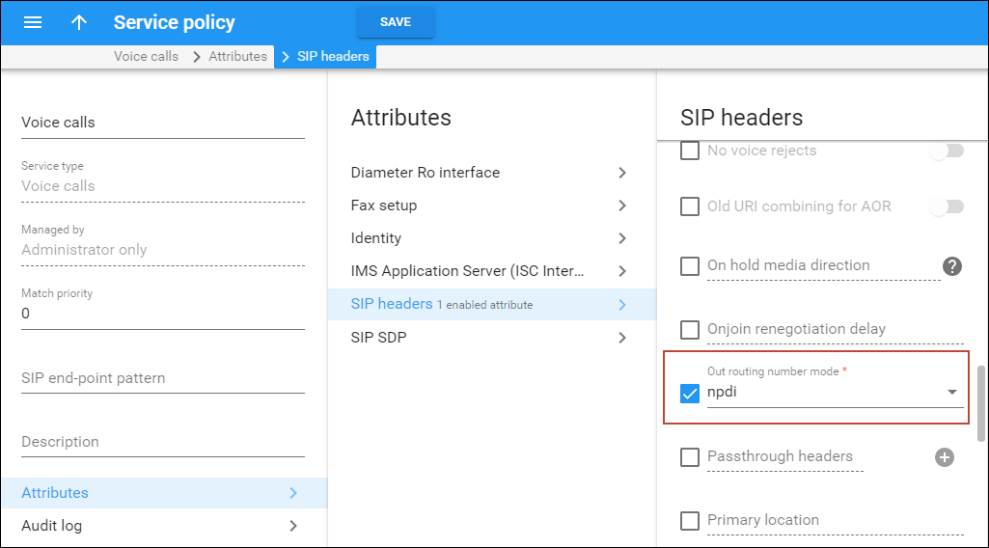
To enable PortaSIP to pass the number portability parameters during the outgoing call, open your service policy for voice calls and do the following:
- On the Attributes panel, select SIP headers.
- On the SIP headers panel, check the box next to the Out routing number mode option and select npdi from the list.
- Click Save on the toolbar.