



Results
The Results panel displays a list of xDRs that match your search query.
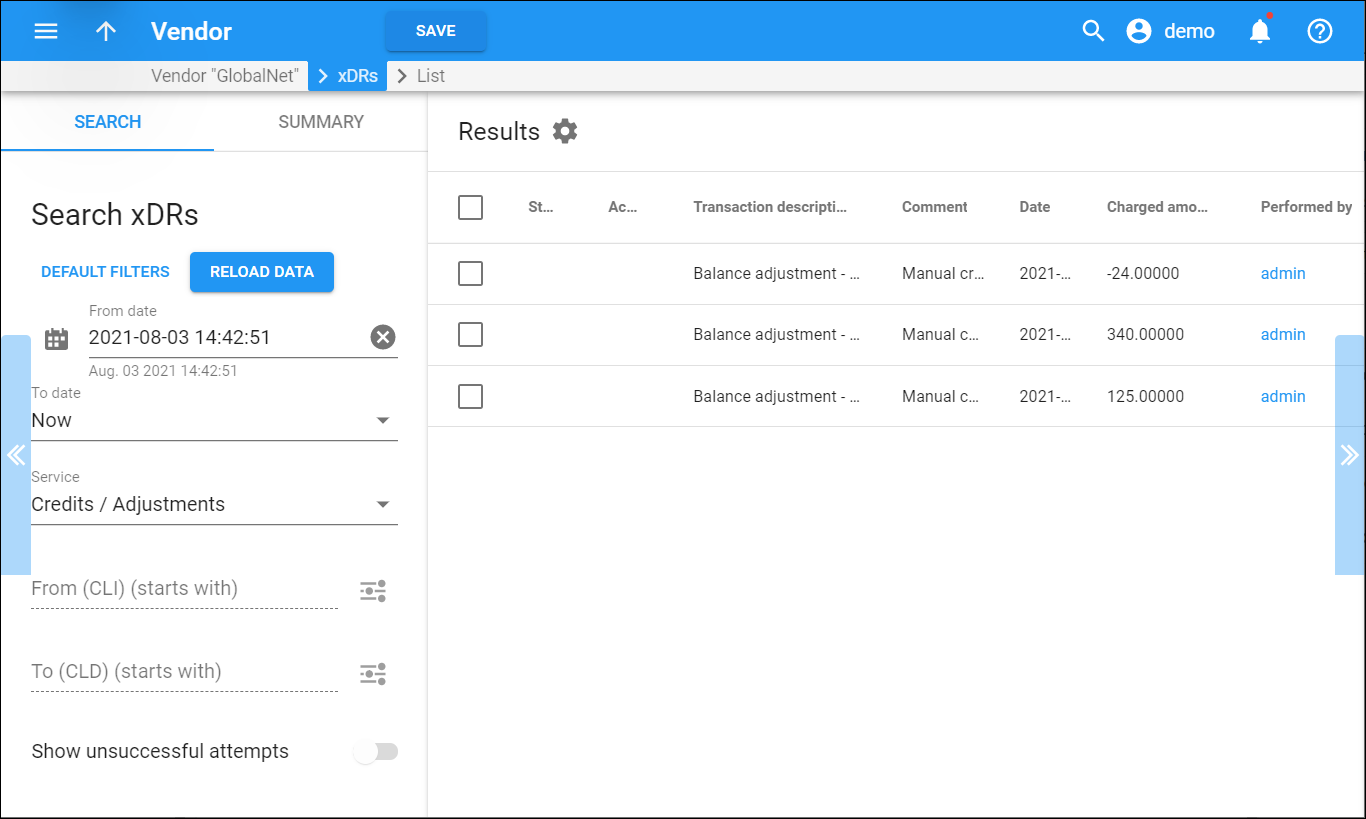
Each entry in this list contains information about account charges: the quantity of service used and the amount charged. For more information about an account click the account link. It will redirect you to the Edit account panel. Note that the information displayed in the xDR list depends on the selected service. These are main columns:
Service
This column is only displayed when “Any” is selected in the Service field on the Search panel. It shows the name of the service, e.g., “Voice calls,” or transaction type, e.g., “Credits/Adjustments.”
Status
This column is only displayed when a specific service is selected in the Service field on the Search panel. It indicates that the xDR has been Reverted  . Refer to the Reverse an xDR chapter for more details.
Account ID
The ID of the account charged. The ID is the link to this account’s page. It is empty if the charge is applied directly to the customer.
Transaction time
Shows the date and time of the transaction.
Charged amount
The applied charge amount.
Call quality
If call quality monitoring is configured, this column shows the voice call quality grades, e.g., “Good,” “Poor,” etc.
To see the call quality details for the filtered xDRs, you must select “Voice calls” in the Service field before applying filters.
Additional info
Shows additional information about the session/transaction, e.g., for voice calls, the called phone number (CLD) is shown.
Details
Click Info  to view the detailed information about the session. There you can see the general information about the session such as time zone, transaction status and/or error code, duration, etc. Click the tabs in the details dialog window to see the session details for an account, reseller and vendor separately. Find the available auxiliary information about the session:
- information about the roaming country and carrier,
- information about PBX calls such as hunt group or an extension number that made, accepted or redirected the call, as well as information about split sessions, if available.
If the Download call record button is unavailable for a successful call, hover over the Info next to it to see the reason. The possible explanations are:
- call recording was off at the time of the call
- recording is still being processed
- codec used during the call is not supported by call recording
The Details column is available for xDRs for Voice calls, Messaging, Netaccess and Conferencing service types.
View log
Click View  to view the log of this session in the Log viewer.
How to download xDRs
To download filtered xDRs in the .csv format, click Download on the toolbar, then click Notifications  on the toolbar, open the notification, and click Download.
xDR summary
Click Summary on the toolbar to view the xDR summary for the selected period. The xDR summary includes the following information:
- Total charges – the sum of charges (except taxes), broken down as:
- Service charges – the sum of all usage charges. Each service is listed separately with its total charges.
- Recurring charges – charges for subscriptions, DID usage, and measured services.
- Other charges – manual charges, one-time fees (such as bundle renewal fees, subscription activation fees, or bundle top-ups), and cleanup xDRs (consolidated records that replace the removed xDRs after the cleanup procedure). Calculated as: Total charges − (Service charges + Recurring charges).
- Taxes – the sum of all tax charges.
- Payments and credits include the following:
- Payments – the sum of all payments.
- Refunds – the sum of all refunds.
- Credits and promotions – the sum of all credits and promotions.
Reverse an xDR
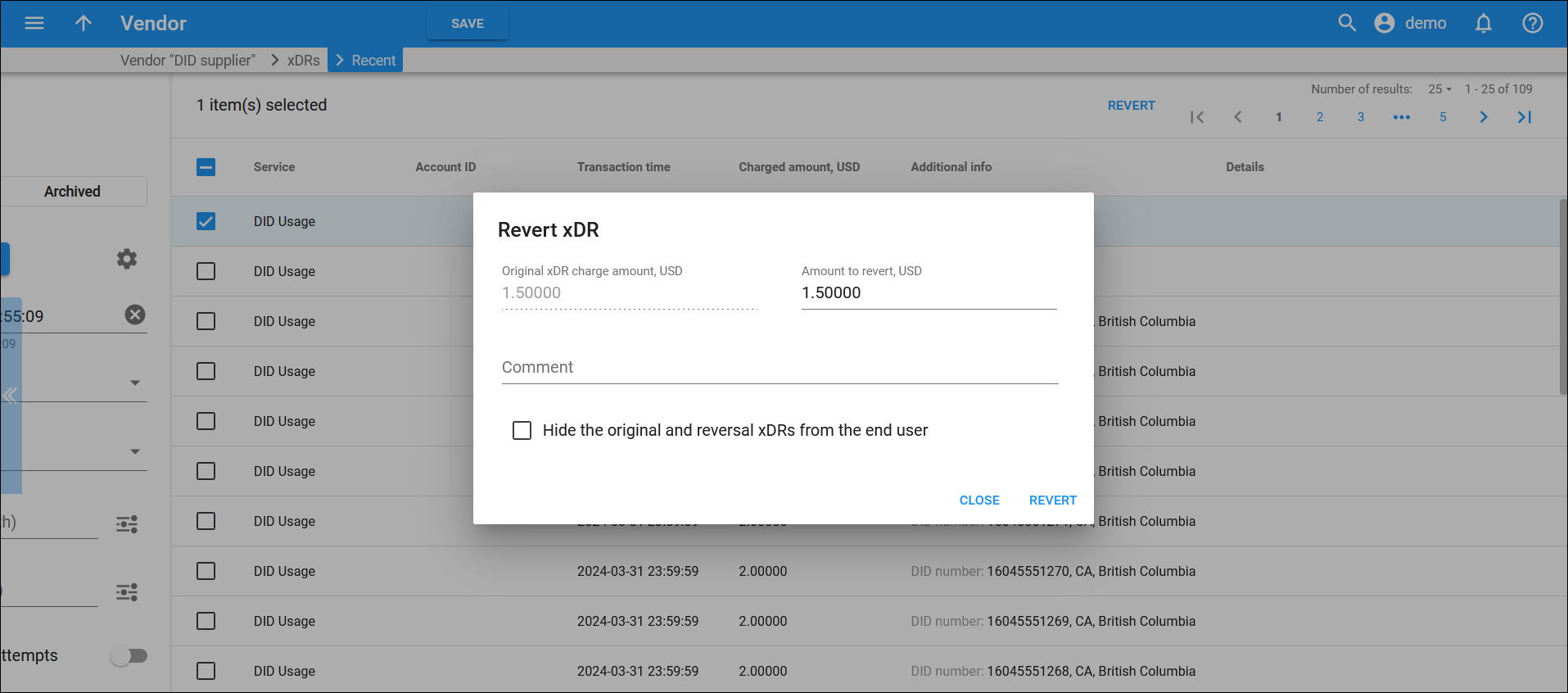
To reverse an xDR, select it from the list and click Revert. Make some comment about your actions (e.g., the reason for the revert).
If you select both aggregated and individual xDRs for reversal, all xDRs included in the aggregated record will be reverted.
To reverse an xDR as if it had never happened, turn on the Hide the original and reversal xDRs from the end user toggle switch. End users will not see these xDRs in their invoices, on self-care interfaces, or in xDR reports. This option is only available when a reverse transaction amount is equal to the original transaction(s) amount and all of the transaction xDRs are included in the open billing period or in the invoice that is under review. For admins, the original and reversal xDRs will be marked as Hidden  .
.
Note that you must be very careful with the Hide the original and reversal xDRs from the end user option. Once an xDR becomes hidden, it’s not possible to reverse it. So if you reverse a transaction by mistake and mark it as hidden, you can only correct that by manually charging for the transaction amount or by importing an analogous xDR.
Customize the panel
- Change table settings – click Settings
 in the title bar to customize columns and change row style.
 - Re-order the columns – drag-and-drop the column headers right or left to place the columns in the order you want.
- Re-order the rows – click Arrow
 (or
(or  ) next to the column header to re-sort the rows. For example, the Vendor xDRs search results list panel displays xDRs in ascending order. You can re-sort them in the reverse order.
 - Change the default number of results globally – use the Number of results drop-down list in the upper right corner to adjust the maximum number of rows that appear on the panel. By default, the panel displays 25 rows. Once the number is changed, it’s automatically saved, so the same number of rows is shown for PortaBilling entities, e.g., customer, account, reseller, etc.


