



E911 (Bandwidth) lets you meet US emergency calling requirements when offering VoIP service. This module integrates PortaSwitch with Bandwidth, an E911 service provider in the US and Canada, to route 911 calls with verified caller location to the correct emergency dispatch center.
When a customer or admin specifies an address for a location (e.g., the office or a specific phone line), PortaSwitch automatically validates and registers the address with Bandwidth. When a user places a 911 call from an IP phone or application, PortaSwitch routes the call to Bandwidth with a Geolocation SIP header that points to the validated address. Bandwidth uses this information to deliver the call to the appropriate Public Safety Answering Point (PSAP), allowing emergency services to dispatch help to the correct location, even if the call is interrupted or the caller cannot speak.
Addresses can be defined at the account, customer site, or customer level. For accounts without an individual address, PortaSwitch automatically falls back to the customer site or customer address – so a single address entered for an office location covers all phone lines there that do not have their own address. To set up emergency calling, the admin simply selects Bandwidth as the E911 provider in a product.
Requirements
- PortaSwitch MR129 or later.
- An active Bandwidth account with E911 Dynamic Location Routing enabled.
- An active subscription to the E911 Bandwidth module in the Add-on Mart.
How it works
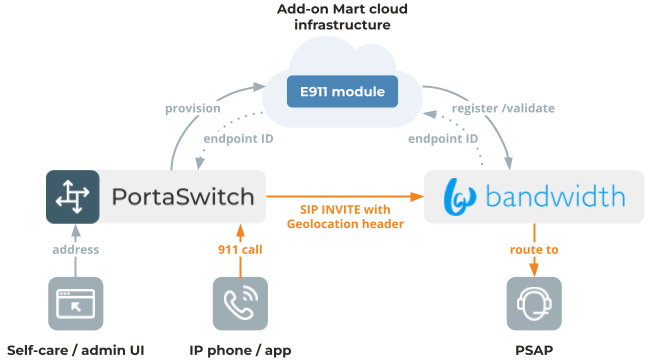
The Add-on Mart cloud infrastructure handles communication between PortaSwitch and Bandwidth’s E911 API. It sends requests to Bandwidth and returns the results to PortaSwitch.
- Location provisioning:
- A customer submits an address for the whole company (customer level), office (customer site level), or phone line (account level) in the self-care portal. Similarly, a service provider’s admin can specify the addresses via the PortaSwitch admin UI.
- PortaSwitch sends the address to the Add-on Mart cloud infrastructure, which calls Bandwidth’s E911 API to create an emergency endpoint with the submitted address. Bandwidth validates and standardizes the address. If the address is invalid, the provisioning fails.
- If validation is successful, Bandwidth creates an endpoint with the registered location and returns an endpoint ID.
- PortaSwitch stores this endpoint ID at the corresponding account, customer site, or customer record.
- Emergency call routing:
-
- When a user dials 911, PortaSwitch identifies this as an emergency call based on the dialing rules and determines that it should be routed to Bandwidth according to the Emergency service setting configured in the account’s product.
PortaSwitch looks up the endpoint ID in the following order: account, customer site, or customer, and uses the first ID it finds.
PortaSwitch includes this ID in a Geolocation SIP header added to the outgoing INVITE request. The header contains a reference URL with the endpoint ID, pointing to the caller’s validated location record at Bandwidth.
- Bandwidth resolves the caller’s location from this reference URL and routes the call to the appropriate Public Safety Answering Point (PSAP) with the caller’s address attached.
- When a user dials 911, PortaSwitch identifies this as an emergency call based on the dialing rules and determines that it should be routed to Bandwidth according to the Emergency service setting configured in the account’s product.
Specifics
- Bandwidth E911 service supports addresses in the United States and Canada.
- PortaSwitch manages Bandwidth endpoint IDs automatically:
- When a new account is created through the PortaBilling web interface, PortaBilling automatically provisions the address to Bandwidth – using the account’s own address (if defined), or falling back to the customer site or customer address.
If an account is created directly via the API and requires an individual address, this address should be specified within a separate API call using the update_account method after the account is created.
- When an address is changed, the existing endpoint is deleted, and a new one is created with the updated address.
- When an account or a customer is closed, the endpoint is deleted from Bandwidth and PortaSwitch.
- When a new account is created through the PortaBilling web interface, PortaBilling automatically provisions the address to Bandwidth – using the account’s own address (if defined), or falling back to the customer site or customer address.
- Once Bandwidth is configured as the emergency module on a product, PortaSwitch automatically provisions existing addresses to Bandwidth for all accounts using that product (if no address is defined for an account, the customer site or customer address is used instead). If provisioning fails for some accounts, admin receives an email notification listing them.
Make sure that the notification “Failed to provision emergency (911) provider-specific codes” is enabled in the admin’s existing notification set.
- Accounts without a validated address can still make emergency calls. These calls are routed to Bandwidth as well, but without location data. In this case, Bandwidth cannot identify the appropriate PSAP and sends the call to the national relay center.
- Location data is delivered to Bandwidth using the Geolocation SIP header in Location-by-Reference (LbyR) mode: PortaSwitch includes a URL that references the caller’s location record stored in Bandwidth. Embedding the caller’s location data directly in the SIP message body using PIDF-LO (Presence Information Data Format – Location Object) is not supported in the current version.
What it delivers to your customers
- 911 calls include verified location data, so emergency services know exactly where to send help – even if the call drops.
What it delivers to you
- Compliant emergency calling for US customers.
- Admins spend less time configuring emergency calls by specifying a single address for all accounts of a specific office.


